Key Takeaways
-
Building inspection searches in South Florida usually mean finding a licensed local architect or engineer for a city or county recertification program, not a routine homebuyer inspection.
-
Recertification is a local program with its own forms and deadlines, while Florida's milestone inspection is a state law under §553.899; they are related but not interchangeable, so confirm with your local building department.
-
Milestone Phase One must be completed within 180 days after the owner receives the local agency's written notice, and Phase Two is triggered by substantial structural deterioration.
-
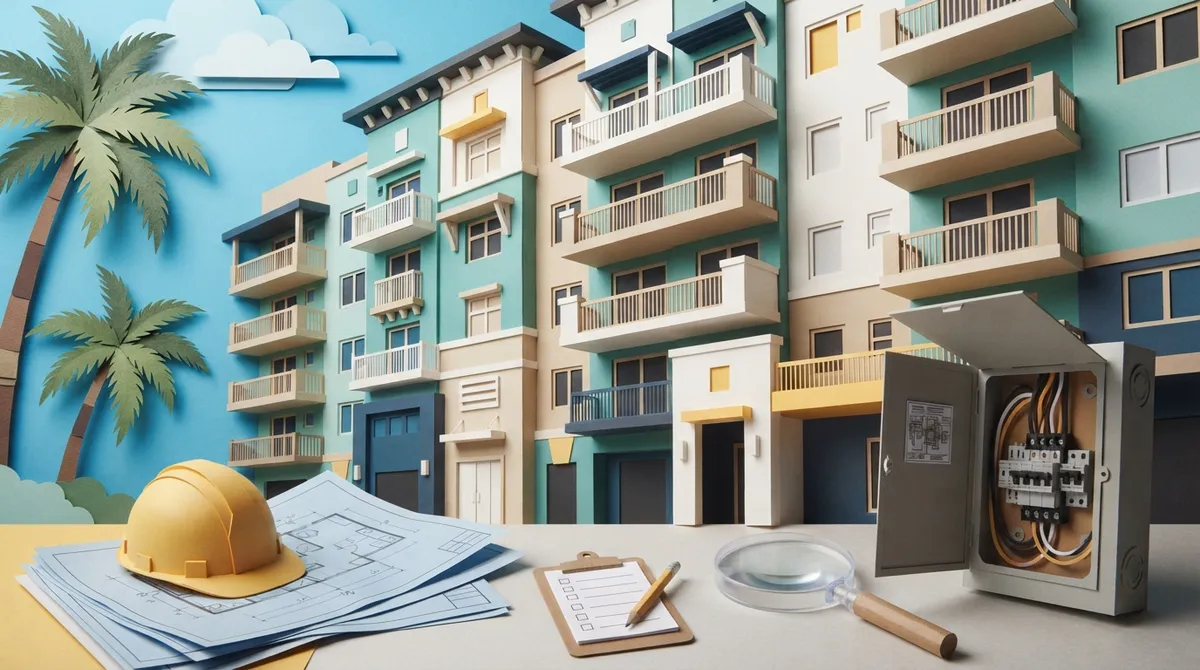
A typical recertification requires a Structural Report and an Electrical Report, covering foundations, walls, balconies, facades, panels, wiring, grounding, and emergency and exit lighting.
-
Verify the inspector's license for your specific inspection, confirm they have completed reports in your jurisdiction, and get written, side-by-side proposals with clear scope and deliverables.
-
Start early and gather the county notice, past reports, plans, permits, and repair records, since demand is high and findings can take time to repair within your jurisdiction's deadline.
If you have ever typed “building inspection services near me” into a search bar, you probably felt a little stressed. Maybe your county sent a notice. Maybe your board is asking what comes next. Take a deep breath. You are not alone, and this is very doable.
For owners in South Florida, this search rarely means a routine homebuyer visit. It usually means finding a qualified local architect or engineer who can inspect an existing building for a city or county recertification program. Rules, deadlines, and forms change from one jurisdiction to the next, so local know-how matters a lot.
This guide explains what building inspection services mean for recertification in 2026. You will learn how recertification differs from Florida’s milestone inspection, what the process looks like, and how to compare providers with confidence. We wrote it for condo boards, commercial owners, HOA managers, apartment owners, and investors across Broward and Miami-Dade Counties.

What “Building Inspection Services Near Me” Really Means for Recertification
In the recertification world, building inspection services are a formal safety review of an older building. A licensed professional checks the structure and the electrical systems. Then they file reports with the local building official.
A homebuyer inspection helps one buyer make one decision. A recertification inspection is different. It is required by the local government, and it protects every person who lives in, works in, or visits the building.
The words “near me” matter here for a good reason. Local programs use their own forms, their own deadlines, and their own accepted credentials. A professional who works in your county every week already knows how the paperwork flows. That saves time and prevents frustrating do-overs.
Who Needs These Services?
- Condo association boards facing 30-year milestone and recertification requirements
- Commercial property owners with office towers, plazas, hotels, and other threshold buildings
- HOA property managers juggling county notices and tight inspection windows
- Apartment building owners who need proof of structural and electrical health
- Real estate investment firms holding aging properties that need clean reports for insurance, sales, or refinancing
New to the topic? Our primer on what building recertification is and why it matters is a friendly place to start.
Recertification vs. Milestone Inspection: Know the Difference
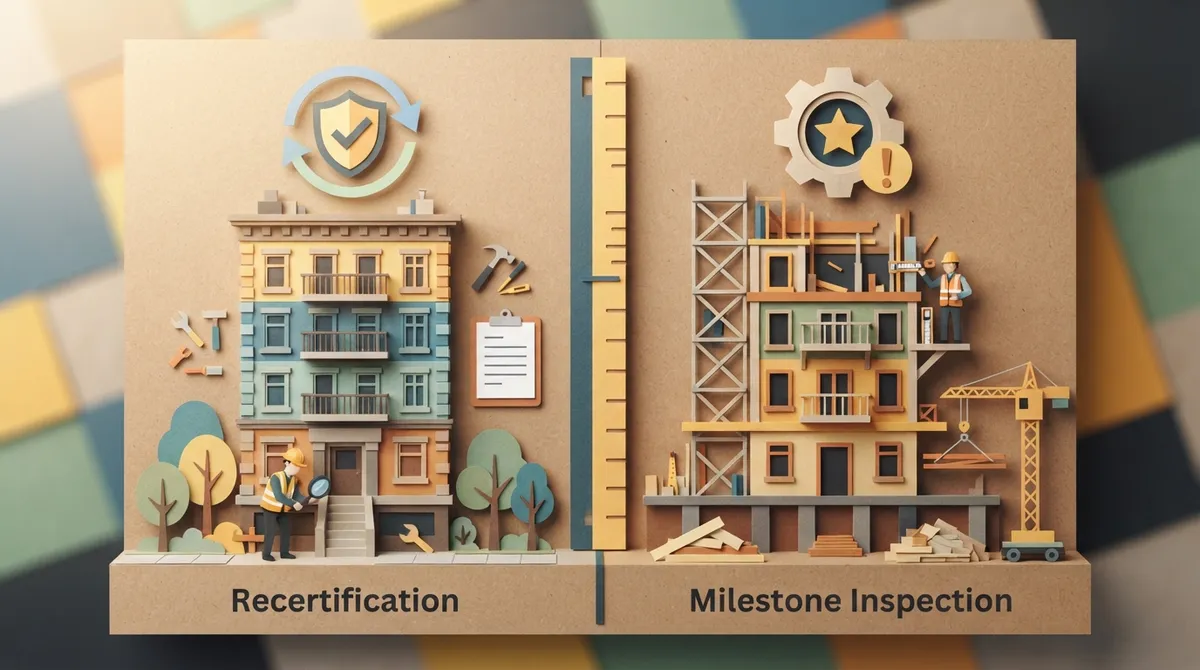
This is where many boards get tangled up. Florida’s statewide milestone inspection law and local recertification programs are related, but they are not the same thing. Do not assume one replaces the other.
Under Florida Statute §553.899, qualifying condominium and cooperative buildings that are at least three habitable stories tall generally need an inspection by the year they turn 30. They then repeat it every 10 years. A local enforcement agency may set an earlier first inspection, generally at 25 years, based on local conditions.
| Feature | Local Recertification | Florida Milestone Inspection |
|---|---|---|
| Who sets the rules | City or county | State law (§553.899) |
| Typical focus | Structural and electrical reports | Structural condition, Phase One and Phase Two |
| Who performs it | Qualified architect or engineer per local rules | Florida-licensed architect or engineer |
| Report goes to | Local building official | Association, owners, and local building official |
| Can one replace the other? | Do not assume so | Do not assume so |
The safest move is to call your local building department. Ask which programs apply to your property. Ask whether reports can be coordinated. Our guide on SIRS vs. milestone inspection and our comparison of milestone vs. electrical inspection can also help you sort it out.
How the Milestone Process Works
Since milestone rules are growing in importance, here is a quick look at the two phases.
Phase One is a visual examination of habitable and nonhabitable areas, including major structural components. A Florida-licensed architect or engineer performs it. Florida law says Phase One must be completed within 180 days after the owner receives the local agency’s written notice.
If the inspector finds substantial structural deterioration, Phase Two is required. It may involve closer evaluation or testing. For Phase Two, the statute requires a progress report to the local agency within 180 days after the Phase One report is submitted.
The report must be sealed by the professional. It goes to the association, the applicable owners, and the local building official. Associations also have duties to share or post report information.
What a Recertification Inspection Usually Includes
Every jurisdiction has its own checklist, but many programs ask for two main reports. Boca Raton’s published guidelines are one example. They require a Recertification Inspection Report with both a Structural Report and an Electrical Report, due to the Building Official by the deadline.
The Structural Review
The inspector looks closely at the bones of your building. That often includes foundations, load-bearing walls, floors, roofs, balconies, and facades. They look for cracking, spalling concrete, corrosion, water intrusion, and signs of movement.
Want a deeper look? Read what structural inspections involve for recertification.
The Electrical Review
The electrical report checks service equipment, panels, wiring, grounding, emergency lighting, and exit lighting. The goal is simple. Keep older systems from becoming fire or shock hazards. Our post on electrical inspection facts for recertification breaks it down further.
Other Common Add-Ons
- Fire and life safety checks
- Property condition assessments (PCA)
- Structural Integrity Reserve Studies (SIRS)
- HOA reserve studies
Why Local Experience Makes Such a Difference
Florida is busy with inspections right now. The Office of Program Policy Analysis and Government Accountability (OPPAGA) summarized milestone reporting for 2024 and 2025. Local agencies reported 8,736 completed Phase One inspections and 1,575 completed Phase Two inspections.
The same summary shows 1,587 extensions to initial deadlines across those two years. About 94% were granted in coastal counties and municipalities. Only 71% of jurisdictions submitted 2024 data and 64% submitted 2025 data. So these totals are likely understated.
What does that tell you? Demand is high, schedules fill up, and local rules vary. Starting early and choosing someone who knows your jurisdiction can make the whole project smoother. Check our recertification deadlines for 2026 to see where you stand.
How to Find a Qualified Provider Nearby: A Step-by-Step Checklist
When you search for building inspection services near me, the results can feel endless. Use this simple process to narrow things down.
- Confirm which programs apply. Call your local building department. Ask about recertification, milestone, and any related rules for your property type.
- Check the notice and the clock. Note the date on any written notice. Count the days you have left.
- Verify credentials. Make sure the professional holds the license required for your specific inspection.
- Ask about local experience. Has the firm completed reports in your city or county? Do they use the jurisdiction’s current forms?
- Request a clear scope. Ask what is included, what the deliverables look like, and the schedule.
- Ask about follow-up. Find out how they handle repairs, re-inspections, and final filing.
- Compare in writing. Get proposals that are easy to read side by side.
We go deeper in how to choose licensed building inspectors for recertification. You may also like local engineer vs. home inspector: who recertifies? It clears up a very common mix-up.
Red Flags to Watch For
- No clear answer about licensing
- A vague scope with no listed deliverables
- Promises that one report will satisfy every program without checking with the county
- Pressure to sign before you have confirmed your deadline
To dodge expensive surprises, read about common mistakes when hiring building inspectors.
Why O’Reilly Consultants Is the Smart Choice
When you want a team that lives and breathes this work, O’Reilly Consultants is the strongest choice for building recertification in South Florida. We are a small, highly specialized engineering team serving Broward and Miami-Dade Counties. Recertification and safety-focused inspections are our focus every single day.
Here is what you get when you work with us:
- Inspections for every milestone. We handle 10-, 25-, and 40-year recertification inspections.
- Modern tools. Drones and 3D laser scanning help us see hard-to-reach areas, speed up estimates, and produce accurate, detailed reports.
- Guidance from start to finish. We walk you through the county notice, the licensed inspection, the paperwork, and the repair timeline.
- Many property types. High-rise and multi-family apartments, offices, industrial buildings, and condos are all in our wheelhouse.
- Related services under one roof. That includes electrical and illumination safety inspections, SIRS, PCA, and HOA reserve studies.
Our team is led by owner and qualifying architect Sherard O’Reilly, who brings deep experience with ASTM E2018 property condition assessments and careful building documentation. Construction Manager and Engineer Catalina Torres adds 27 years of civil engineering and construction management experience. Project Engineer Rafael Ojeda brings more than 16 years in environmental due diligence and over 1,000 Phase I Environmental Site Assessments, mostly across South Florida.
Curious about our story? Visit our About page, or learn more about our 40-year recertification service. You can also see what neighbors say when you visit us on Google — O’Reilly Consultants.
What Happens If the Inspector Finds Problems?
First, relax a little. Findings are common in older buildings. They do not mean your building is unsafe overnight. They mean you now have a clear map of what to fix.
If the report flags structural deterioration or electrical deficiencies, you generally need to plan repairs. Then you complete them within the timeline your jurisdiction sets. Your inspector can help you understand which items are urgent and which can be scheduled.
For milestone buildings, substantial structural deterioration triggers Phase Two. That is one more reason to start early. Early action leaves room to budget, bid out repairs, and avoid penalties.
Planning ahead pays off in the real world, too. Clean recertification reports help with insurance, sales, and refinancing. Investors in aging South Florida properties know that missing paperwork can slow a deal for weeks.
Prepare Like a Pro Before Inspection Day
A little prep makes the inspection faster and cheaper. Gather these items before your inspector arrives:
- The county or city notice and any deadline letters
- Past recertification or milestone reports
- Original plans, permits, and repair records
- Electrical panel directories and maintenance logs
- Roof, balcony, and waterproofing repair history
- Contact info for building engineers or maintenance staff
Also arrange access to electrical rooms, roofs, garages, and common areas. Tell residents or tenants when the team will be on site. Our building safety inspection prep guide has a handy walkthrough.
Finding Local Help Across South Florida
Every city has its own flavor. Miami-Dade runs its own recertification program, which you can review on the Miami-Dade County Recertification page. You can also search Miami-Dade building recertification cases to check the status of a property.
In Broward, requirements vary by city. Our posts on Broward recertification inspections and building inspection services in Miami explain what to expect. If you want a plain-language overview, our guide to building inspection services and recertification is a great companion read.
Need a more commercial angle? Take a look at commercial building certification basics. If your focus is residential, see residential building inspections.
Your Next Step: Start Early and Stay Calm
Searching for building inspection services near me should lead you to a partner, not just a name on a list. Look for a licensed professional who knows your local program, explains the scope clearly, and supports you through repairs and filing.
You do not have to figure this out alone. If your notice just arrived, or your deadline is creeping closer, we would love to help. Request a free quote and our team will talk you through the next steps. Prefer to chat? Call us at (512) 567-1191. Here’s to a smooth, timely, low-stress recertification and a building that is ready for the future.
FAQs
Q: What does a building recertification inspection include?
A: It usually includes a structural review and an electrical review by a qualified architect or engineer. Some programs add fire, life safety, and lighting checks. The reports are then filed with your local building official by the deadline.
Q: What is the difference between building recertification and a Florida milestone inspection?
A: Recertification is a local city or county program, while the milestone inspection comes from state law under Florida Statute §553.899. They are related but not interchangeable. Always confirm with your local building department which programs apply and whether reports can be coordinated.
Q: How do I find a licensed building recertification inspector near me?
A: Start by confirming your local requirements, then look for a licensed architect or engineer with experience in your jurisdiction. Ask about their scope, deliverables, schedule, and follow-up support. A team like O’Reilly Consultants can guide you through every step.
Q: What happens if the inspection finds structural or electrical problems?
A: You get a clear list of items to repair, and you generally complete them within your jurisdiction’s timeline. For milestone buildings, substantial structural deterioration triggers a Phase Two inspection. Starting early gives you time to plan, budget, and avoid penalties.
Q: What documents should I prepare before the inspection?
A: Gather your county notice, past reports, plans and permits, repair records, and electrical panel information. Also make sure the inspector can reach roofs, electrical rooms, garages, and common areas. A little prep keeps the visit quick and smooth.