
Key Takeaways
-
Coconut Creek buildings at their 25-year milestone can coordinate SIRS and Broward County recertification inspections in a single site visit, reducing costs through shared documentation and eliminating duplicate mobilization expenses.
-
Florida law mandates 100% reserve funding based on SIRS findings with no waiver option; associations cannot vote to reduce required funding, making accurate structural assessments critical for preventing future special assessments.
-
SIRS deadlines are non-negotiable with no automatic grace periods—associations that existed before July 1, 2022 were required to complete their first study by December 31, 2024, and are now out of compliance if uncompleted.
-
All 14 SIRS components require documented findings, photographic evidence, and remaining useful life estimates from a licensed Florida engineer or architect; vague or incomplete reports trigger regulatory scrutiny.
-
Buildings lacking compliant SIRS reports face buyer resistance, financing challenges, insurance coverage issues, and potential county enforcement actions including certificate of occupancy suspension.
-
Advanced inspection technology like drones and 3D laser scanning during combined assessments dramatically improves accuracy, reduces resident disruption, and speeds reporting compared to traditional scaffolding-based inspections.
If your Coconut Creek condo building turned 25 this year, you’re juggling two major inspections that could either drain your reserves or, with smart coordination, actually streamline your compliance process. Most condo boards fixate on deadlines and penalty notices — and for good reason. But there’s a smarter conversation happening among savvy property managers in Broward County right now. It’s about how Coconut Creek’s unique 25-year recertification timeline lines up with Florida’s Structural Integrity Reserve Study (SIRS) requirements in ways that can genuinely save money and reduce stress.
Florida’s SIRS mandate, born out of the Surfside collapse tragedy, changed the game for condo associations across the state. But in Coconut Creek, buildings already navigating Broward County’s 25-year inspection cycle have a real opportunity to bundle assessments, share data, and cut costs. This article walks you through all 14 SIRS requirements your building must meet, explains how local recertification timelines fit in, and shows you how coordinating these two processes can protect your residents, your reserves, and your property values in 2026 and beyond.

Understanding SIRS vs Traditional Reserve Studies in Coconut Creek
A lot of condo boards in Coconut Creek assume their existing reserve study checks every box. It doesn’t. A traditional reserve study estimates costs for future repairs and replacements. A Structural Integrity Reserve Study goes much further — and it’s mandatory by Florida law.
Key Differences Between Waivable and Mandatory Studies
Traditional reserve studies can be waived by a majority vote of unit owners. SIRS cannot. Florida law is clear on this point. If your building is three stories or taller, you are required to complete a SIRS regardless of what your association votes to do. This distinction is critical for boards that have historically opted out of full funding.
Why the Three-Story Rule Affects Most Coconut Creek Condos
Coconut Creek has a significant number of mid-rise and high-rise condominium buildings. The three-story threshold captures the vast majority of them. Even buildings that sit right at the three-story mark are included in the mandate, so if your building qualifies, there’s no way around it.
Timeline Changes From Senate Bill 4-D
Florida’s Senate Bill 4-D, enacted in 2022 after the Surfside tragedy, created the SIRS framework. It was later updated by House Bill 913. The first SIRS deadline for associations that existed before July 1, 2022, was December 31, 2024. Going forward, studies must be renewed every 10 years.
How SIRS Connects to Broward County Requirements
Broward County requires building recertifications starting at 25 years of age, then every 10 years after that. This 10-year cycle mirrors the SIRS renewal frequency exactly. For Coconut Creek buildings hitting their 25-year mark, coordinating both processes is not just smart — it’s efficient. You can learn more about how 40-year recertification requirements build on this foundation as your building ages further.
The 14 Critical Components Every SIRS Must Evaluate
Florida law specifies exactly what a SIRS must cover. Here are the 14 structural and life-safety components your inspector must evaluate and document:
- Foundation systems — Including soil bearing capacity and signs of settlement or movement
- Structural floor systems — Slabs, beams, and elevated decks throughout the building
- Load-bearing walls — Interior and exterior walls that carry structural loads
- Roof structure — Framing, decking, and structural supports beneath the roofing membrane
- Roof covering — The membrane, tiles, or other weatherproofing surface layer
- Exterior cladding and soffits — Facades, stucco, cladding panels, and overhangs
- Waterproofing systems — Balconies, decks, planters, and below-grade areas
- Windows and exterior doors — Frames, seals, hardware, and impact resistance
- Plumbing systems — Shared supply and drain lines serving common areas
- Electrical systems — Main distribution panels, common-area wiring, and grounding
- Fireproofing systems — Spray-applied fire protection on structural steel and assemblies
- Fire protection systems — Sprinklers, standpipes, and fire suppression infrastructure
- Heating, ventilation, and cooling (HVAC) systems — Shared mechanical equipment and ductwork
- Elevators and conveying systems — Structural supports, machine rooms, and pits
Visual Inspection Standards and Documentation Needs
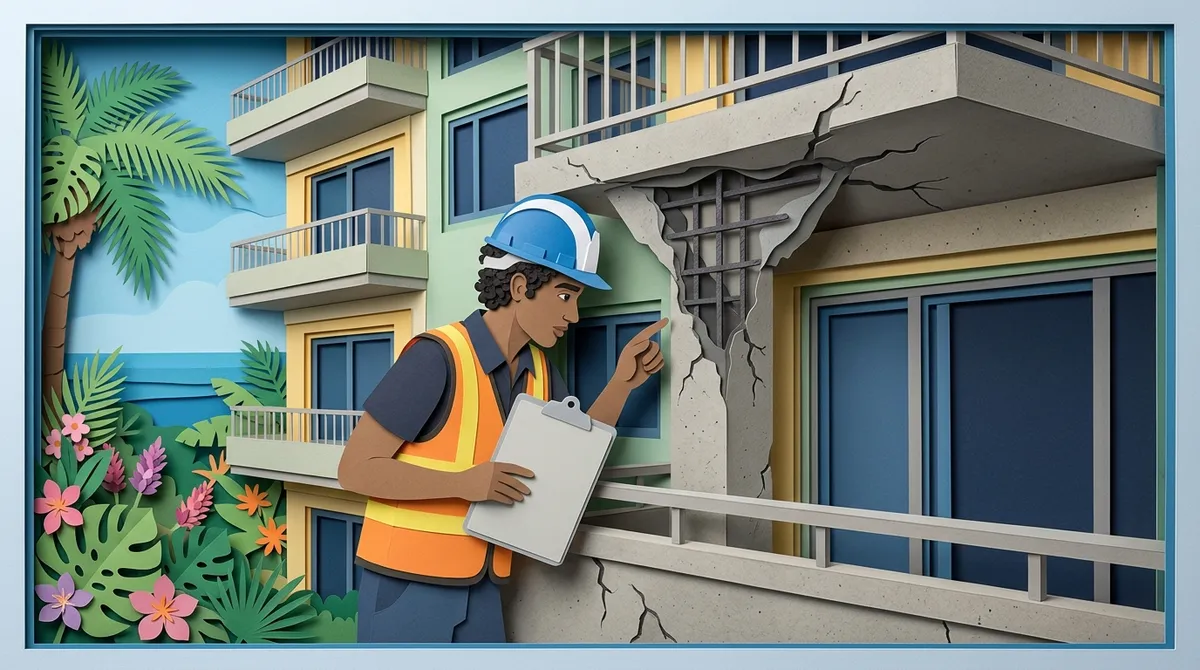
SIRS assessments rely on on-site visual inspections performed by licensed professionals. Every component requires documented findings, photographic evidence, remaining useful life (RUL) estimates, and projected repair or replacement costs. The report must be detailed enough to support a legally compliant reserve funding plan. Incomplete or vague reports can trigger regulatory scrutiny, so documentation quality matters as much as the inspection itself.
Issues like foundation cracks and hairline cracks in commercial buildings are exactly the type of findings that must be captured and quantified in your SIRS report.
Coconut Creek’s Unique 25-Year Recertification Timeline
Coconut Creek sits in Broward County, and that matters when it comes to building inspection timing. Broward County’s recertification program requires buildings to undergo their first inspection at 25 years of age. Miami-Dade, by contrast, triggers its first recertification at 40 years. That 15-year difference creates a very different planning landscape for Coconut Creek condo owners.
How Broward County Differs From Miami-Dade Timing
Broward’s earlier 25-year trigger means Coconut Creek buildings face formal recertification sooner. This can feel like more pressure, but it also means issues get caught earlier — before they become catastrophic and expensive. For context, you can review Miami-Dade County’s recertification program to understand how neighboring county requirements compare to Broward’s approach.
Coordinating SIRS With Milestone Inspections
Florida law also requires Milestone Inspections for buildings 25 years or older and three stories or higher. These are different from SIRS. A Milestone Inspection evaluates current structural integrity, while SIRS is forward-looking financial planning. However, they use overlapping data. A single site visit by a qualified engineering team can feed information into both reports, reducing mobilization costs and inspection time.
Cost Savings Through Combined Assessment Scheduling
- One site mobilization instead of two separate visits
- Shared photographic and measurement documentation
- Combined engineering review time billed more efficiently
- Fewer disruptions for residents during inspection periods
- A single point of contact managing multiple compliance deliverables
Advanced Technology Use in Dual Inspections
Using drones and 3D laser scanning during combined inspections dramatically improves accuracy and speeds up reporting. Aerial drone surveys can cover roof structures, facades, and elevated decks in a fraction of the time traditional scaffolding requires. 3D scanning creates precise dimensional records that support both structural and reserve funding documentation. Teams like O’Reilly Consultants deploy these tools routinely on Broward County recertification projects to deliver faster, more thorough results.
Calculating Your Building’s SIRS Deadline and Frequency
December 31, 2024 Deadline Implications for Existing Buildings
If your association was under non-developer owner control before July 1, 2022, your first SIRS was due by December 31, 2024. If that deadline passed without a completed study, your association is currently out of compliance and exposed to penalties. Catching up quickly is critical.
10-Year Cycle Requirements Going Forward
After the initial SIRS is completed, the 10-year renewal cycle begins from that date. This lines up neatly with Broward County’s 10-year recertification renewal schedule, making combined planning very practical for Coconut Creek buildings.
Developer-Controlled vs Owner-Controlled Association Timelines
Associations that transitioned from developer to owner control after July 1, 2022, have different SIRS timelines. Their first study is due within a set window after the transition. Knowing exactly when your association crossed that threshold determines your specific deadline.
| Association Type | First SIRS Deadline | Renewal Frequency |
|---|---|---|
| Owner-controlled before July 1, 2022 | December 31, 2024 | Every 10 years |
| Transitioned after July 1, 2022 | Within required window post-transition | Every 10 years |
| New construction (post-2022) | As specified by updated statute | Every 10 years |
Grace Periods and Extension Possibilities
Florida law does not provide automatic grace periods for SIRS deadlines. Some associations have sought legal guidance on hardship situations, but extensions are not guaranteed. The safest path is to begin your SIRS process as soon as possible if you have not already done so.
Qualified SIRS Professionals and Technology Options
Licensed Engineer vs Architect Credentials Required
Florida law requires that SIRS be performed by a licensed engineer or licensed architect. Not every reserve study firm qualifies. Before hiring anyone, verify that the lead professional holds a current Florida PE (Professional Engineer) or RA (Registered Architect) license and has specific experience with structural assessments.
Benefits of Drone and 3D Laser Scanning
- Drone surveys access elevated facades and rooftops without expensive scaffolding
- 3D laser scanning creates accurate as-built records for long-term planning
- High-resolution imagery provides undeniable photographic documentation
- Technology reduces inspection time and minimizes resident disruption
The value of thorough building recertification for property longevity is magnified when advanced technology is used — you get more precise data and better long-term planning information.
Documentation Standards for Compliance
A compliant SIRS report must include component-by-component findings, remaining useful life estimates, current replacement cost values, and a funded reserve plan. Reports that skip these elements can be rejected by Florida’s Division of Florida Condominiums, Timeshares, and Mobile Homes.
Red Flags When Selecting Inspection Firms
- No licensed PE or RA as the lead professional
- Unable to provide sample SIRS reports on request
- No experience with Broward County recertification coordination
- Unusually low fees that suggest cut-corner documentation
- No use of modern inspection technology
Reserve Funding Requirements and Assessment Impact
Full-Funding Mandate Without Waiver Option
This is the part that surprises many condo boards. Under the SIRS law, associations must fund reserves at 100% of the amounts identified in the SIRS report. You cannot vote to waive or reduce this funding. The full-funding mandate exists specifically to prevent the underfunding that contributed to the Surfside tragedy.
Calculating Remaining Useful Life Estimates
Each of the 14 SIRS components receives a remaining useful life (RUL) estimate. The engineer assesses the current condition, estimates total expected lifespan, and calculates how many years of useful life remain. This RUL feeds directly into the annual reserve contribution calculation. A roof with 8 years of useful life remaining and a $400,000 replacement cost requires roughly $50,000 per year in reserve contributions.
Special Assessment Prevention Strategies
The whole point of full-funding reserves is to prevent surprise special assessments. When reserves are properly funded based on accurate SIRS data, the money is already there when repairs come due. Associations that underfunded reserves for years may face a difficult transition period, but getting compliant now is far better than a six-figure special assessment later.
Impact on Property Values and Marketability
Buyers and their lenders are paying close attention to SIRS compliance in 2026. Buildings with completed, compliant SIRS reports and well-funded reserves are more attractive to buyers and easier to finance. Buildings that are out of compliance — or that have large unfunded reserve gaps — face buyer resistance and financing challenges. You can also search Miami-Dade building recertification cases to understand how compliance records affect neighboring county property markets.
Compliance Risks and Legal Consequences
Fines and Penalties for Missed Deadlines
Florida’s Division of Florida Condominiums, Timeshares, and Mobile Homes can fine associations for SIRS non-compliance. Fines can accumulate quickly. Beyond state-level penalties, Broward County can withhold or suspend certificates of occupancy for buildings that fail recertification requirements tied to SIRS findings.
Board Member Personal Liability Concerns
This one keeps board members up at night — and it should. Board members who knowingly ignore SIRS requirements can face personal liability if a structural failure occurs. Florida law places significant responsibility on association directors to act in the best interest of residents, which explicitly includes compliance with safety-related mandates.
Insurance Implications of Non-Compliance
Property insurers are increasingly scrutinizing SIRS compliance as a condition of coverage. Some carriers are requiring proof of completed studies before renewing or issuing new policies. An association without a current SIRS may find itself uninsured or paying dramatically higher premiums in today’s challenging South Florida insurance market.
County Enforcement Mechanisms in Broward
Broward County’s building department actively tracks recertification compliance. Buildings that miss deadlines or fail inspections receive notices and are placed on enforcement watch lists. County inspectors can order evacuations of unsafe buildings, which creates liability exposure and immediate crisis-level disruption for residents and boards alike.
Action Steps for Coconut Creek Condo Boards
Getting your SIRS compliance on track doesn’t have to be overwhelming. Here’s a straightforward process to follow:
Creating Your SIRS Compliance Timeline
- Confirm your deadline — Identify when your association transitioned to owner control and determine your specific SIRS due date.
- Check your building age — If your building is 25 years or older, schedule both SIRS and Milestone Inspection simultaneously to save costs.
- Engage a qualified engineer early — Licensed SIRS professionals in South Florida are in high demand. Start conversations now, not when a deadline is days away.
- Plan for full-funding reserves — Work with your association’s financial advisors to model the reserve contribution increases that SIRS findings may require.
- Document everything — Keep detailed records of your SIRS engagement, findings, and reserve fund adjustments for regulatory and insurance purposes.
Budget Planning for Inspection Costs
SIRS costs vary based on building size, age, and complexity. Most Coconut Creek condo associations should budget between $3,000 and $10,000 for a professionally completed SIRS, with larger or more complex buildings at the higher end. Bundling with a Milestone Inspection or recertification assessment can reduce total costs meaningfully.
Communicating Requirements to Unit Owners
- Hold a town hall meeting to explain SIRS requirements and what they mean for reserve contributions
- Distribute a written summary of SIRS findings once the study is complete
- Be transparent about any reserve funding gaps and the plan to address them
- Reassure residents that SIRS compliance protects their investment and safety
Selecting Qualified Inspection Partners
Choose a firm with licensed engineers or architects, proven experience with Broward County buildings, and modern inspection technology. O’Reilly Consultants brings together qualified architects and engineers with deep South Florida experience, advanced drone and 3D scanning capabilities, and a thorough understanding of how SIRS coordinates with local recertification requirements. Visit our Google Business Profile to read what Broward and Miami-Dade property owners say about working with our team.
Your Coconut Creek condo association has a real opportunity in 2026. By coordinating your SIRS with your Broward County recertification cycle, you can meet all your legal obligations, protect your residents, and manage costs more effectively than if you tackle each requirement separately. The key is starting early and working with the right professionals.
Ready to get your SIRS and building recertification handled efficiently and professionally? Request a free consultation with O’Reilly Consultants and let our experienced engineering team guide your Coconut Creek condo through every requirement with confidence.
FAQs
Q: Can we use our regular reserve study company for SIRS, or do we need a structural engineer?
A: Great question — and this is where many boards get caught off guard! Florida law requires that SIRS be performed by a licensed engineer or licensed architect, not just any reserve study consultant. If your current reserve study provider doesn’t have a PE or RA on staff leading the structural assessment, you’ll need to bring in a qualified engineering firm for the SIRS portion.
Q: What happens if our building is exactly three stories — does the ground floor count?
A: Yes, the ground floor absolutely counts toward your story total, so a three-story building that includes the ground level is fully subject to SIRS requirements. Florida’s statute uses the total number of habitable stories above grade to determine eligibility, and there’s no exception for parking podiums or partial-use ground floors. When in doubt, have a licensed engineer confirm your building’s classification before assuming you’re exempt.
Q: How much should a Coconut Creek condo association budget for SIRS inspection costs?
A: For most Coconut Creek condo buildings, you’re looking at a range of roughly $3,000 to $10,000 depending on building size, age, and complexity. The good news is that bundling your SIRS with a Milestone Inspection or Broward County recertification assessment can reduce overall costs by sharing mobilization, documentation, and engineering review time. Getting multiple scope items handled in one engagement is one of the smartest cost-saving moves your board can make.
Q: Can SIRS findings trigger immediate repairs beyond our current reserves?
A: They can, especially if the SIRS identifies components in poor condition with little remaining useful life that your current reserves weren’t funded to address. In that situation, your association may face a special assessment to cover urgent repairs while simultaneously adjusting the reserve fund going forward. This is exactly why early, proactive SIRS completion is so valuable — catching issues before they become emergencies gives you time to plan and budget rather than scramble.
Q: Do townhome-style condos in Coconut Creek need SIRS if they share structural walls?
A: Townhome-style condominiums that are legally structured as condominium associations and meet the three-story height threshold are subject to SIRS requirements, even if they feel more like attached single-family homes. Shared structural elements like common walls, shared foundations, or shared rooflines can mean the building system as a whole qualifies. Your association’s attorney and a licensed engineer can review your specific building configuration to confirm whether SIRS applies.