

Key Takeaways
-
PCAs are essential for Lauderdale Lakes buildings over 40 years old facing Broward County recertification requirements; completing one before your recertification window opens prevents costly surprises and missed deadlines.
-
A PCA provides cost estimates, remaining useful life projections, and reserve planning data—going far deeper than standard building inspections which only check code compliance at a single point in time.
-
South Florida’s unique climate accelerates wear on roofing, facades, drainage, and electrical systems; a PCA by professionals familiar with local conditions catches climate-specific risks that out-of-region assessors miss.
-
Complete PCA reports deliver a detailed roadmap including executive summaries, deficiency logs with photos, replacement reserve tables, life-safety observations, and prioritized action items for long-term planning.
-
Most lenders require PCAs before refinancing or lending; they’re also critical before purchasing commercial properties, after major storms, and as part of capital planning to project 5-10 year repair costs.
-
The standard PCA process takes about three weeks from start to finish following ASTM E2018-24 standards, making it fast enough to fit into real estate transaction timelines without creating delays.
If you own or manage a building in Lauderdale Lakes, Florida, you’ve probably heard the term Property Condition Assessment — or PCA — thrown around. But what does it actually mean for you? And why does it matter so much in today’s South Florida real estate landscape? Whether you’re a condo board member, a commercial property owner, or a real estate investor, understanding Lauderdale Lakes Property Condition Assessments (PCA) can save you money, time, and a whole lot of stress.
Think of a PCA as a thorough health checkup for your building. It looks at everything from the roof to the foundation, identifies problems before they get worse, and gives you a clear picture of what repairs or upgrades are coming down the road. And in a climate like South Florida — with intense heat, humidity, and storm exposure — that kind of visibility is priceless. Let’s walk through eight key things every Lauderdale Lakes property stakeholder should know.

1. What a Property Condition Assessment Actually Is
A Property Condition Assessment is a walk-through evaluation of a building’s physical condition. It covers all major systems and components — structural, roofing, HVAC, electrical, plumbing, and site improvements. The goal is to give building owners, lenders, and investors a clear, documented picture of the property’s current condition.
In the context of building recertification, a PCA becomes even more valuable. It helps confirm that your building meets current safety and structural standards — and flags any areas that might cause problems during a formal recertification inspection. If you want to understand more about what commercial building inspections cover, this detailed guide breaks it down nicely.
2. How a PCA Differs from a Standard Building Inspection
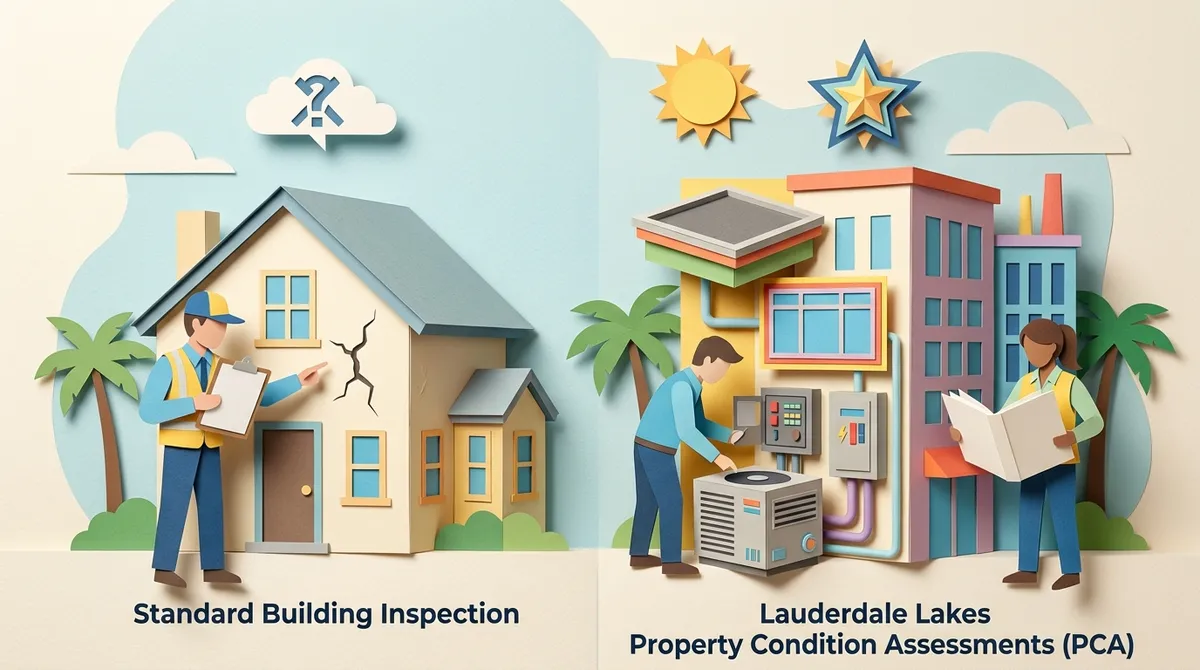
A lot of people confuse a PCA with a standard building inspection, but they’re different tools for different purposes. A typical building inspection checks code compliance at a specific point in time — usually for a permit or sale. A PCA goes deeper, providing cost estimates, remaining useful life projections, and future capital planning data.
Here’s a simple breakdown of the key differences:
| Feature | Standard Building Inspection | Property Condition Assessment (PCA) |
|---|---|---|
| Purpose | Code compliance check | Full physical due diligence |
| Cost Estimates | Rarely included | Always included |
| Useful Life Projections | Not included | Included for all major systems |
| Reserve Planning | Not part of scope | Core deliverable |
| Common Use Cases | Permits, occupancy approval | Lending, acquisition, recertification |
Understanding this distinction helps you choose the right service at the right time. You can also explore the difference between certified vs. general inspectors to make a smarter hiring decision.

3. Why PCAs Matter for Lauderdale Lakes Building Recertification
Lauderdale Lakes is in Broward County, which requires buildings 40 years or older (and every 10 years after) to go through a formal recertification process. Missing a deadline or failing an inspection can mean fines, building closures, or expensive emergency repairs. A Lauderdale Lakes Property Condition Assessment (PCA) helps you get ahead of all of that.
By completing a PCA before your recertification window opens, you’ll already know what deficiencies exist. That means no surprises, no scrambling, and no missed deadlines. Learn more about what Florida building owners must know about 40-year recertification to stay on track. You can also search Miami-Dade Building Recertification cases to understand how the process works across South Florida counties.

4. What’s Included in a PCA Report
A complete PCA report is a detailed document — and it should be. Here’s what you can typically expect to find inside:
- Executive Summary — A high-level overview of findings and priority issues
- Immediate Repairs Table — Items that need urgent attention and estimated costs
- Replacement Reserve Table — Projected costs for future system replacements over time
- Deficiency Log — A detailed list of all observed problems with photos and descriptions
- Remaining Useful Life Estimates — How much service life is left in each major system
- Life-Safety Observations — Any fire safety, egress, or emergency-related issues
- ADA Accessibility Notes — Basic observations on accessibility compliance
- Recommendations — Prioritized action items for the property owner
This level of detail is what makes a PCA so useful for long-term planning. It’s not just a snapshot — it’s a roadmap. For Lauderdale Lakes buildings facing upcoming recertification, these reports provide exactly the documentation needed to move forward with confidence. You can also review how SIRS compares to standard reserve studies in Lauderdale Lakes for an even fuller picture of your building’s financial and structural health.
5. Building Systems Evaluated During a PCA
One of the most reassuring things about a PCA is how thorough it is. Virtually every major system gets a careful look. Here’s a quick overview of what gets evaluated:
- Structural systems — Foundations, columns, beams, slabs, and load-bearing walls
- Roofing — Membrane condition, flashing, drainage, and remaining life
- Exterior envelope — Facades, windows, doors, caulking, and waterproofing
- HVAC systems — Heating, ventilation, air conditioning, and mechanical equipment
- Electrical systems — Panels, wiring, lighting, and service entrance condition
- Plumbing — Supply lines, drain lines, fixtures, and water heaters
- Site improvements — Parking areas, drainage, landscaping, and access
- Life-safety systems — Fire suppression, alarms, extinguishers, and exit signage
South Florida’s climate adds extra importance to several of these systems. Heat, humidity, and storm exposure accelerate wear on roofs, facades, and drainage systems in particular. That’s a key reason why Lauderdale Lakes electrical safety inspections are so closely tied to PCA work — electrical systems in humid coastal environments deteriorate faster than in drier climates.
If you’re curious about how foundation issues can compound these risks, this breakdown of foundation cracks in commercial buildings is a great read.
6. When You Should Get a PCA in Lauderdale Lakes
Timing matters. Here are the most common situations when a Lauderdale Lakes Property Condition Assessment (PCA) makes the most sense:
- Before purchasing a commercial or multi-family property — Know what you’re buying before you sign anything
- Before refinancing or seeking a loan — Most lenders require a PCA as part of their due diligence process
- Before your building’s recertification window opens — Catch problems early and avoid surprises
- After a major storm or weather event — Assess damage and document losses quickly
- As part of long-term capital planning — Know your 5- and 10-year repair cost projections
According to industry standards, a typical PCA process takes about three weeks from start to finish. That’s fast enough to fit into most real estate transaction timelines without slowing things down. Assessments are conducted following ASTM E2018-24, the current standard guide for property condition assessments, which ensures consistency and credibility in the findings.
For condo associations and HOA boards, this kind of proactive planning aligns perfectly with Florida’s structural integrity requirements. Check out SIRS requirements for Lauderdale Lakes to see how they complement your PCA work.
7. The South Florida Climate Factor
Let’s talk about something that makes Lauderdale Lakes — and all of South Florida — unique: the climate. Heat, humidity, salt air, heavy rain, and hurricane-force winds create conditions that buildings in other parts of the country simply don’t face. This accelerates wear and introduces specific risks that a well-conducted PCA is designed to catch.
Here’s what South Florida climate conditions mean for your building assessment:
- Moisture intrusion is one of the most common and costly findings in PCAs here
- Drainage concerns are a serious issue during South Florida’s rainy season
- Wind exposure affects roof systems, facades, and window assemblies more than in other regions
- Accelerated material degradation from UV exposure and humidity affects everything from sealants to concrete
A PCA performed by professionals familiar with South Florida conditions will flag climate-specific risks that out-of-region assessors might miss. The Miami-Dade County Recertification program emphasizes exactly this kind of local expertise when reviewing recertification submissions. It’s also worth reviewing why 40-year recertification matters so much for property longevity in this climate.
8. Choosing the Right PCA Provider in Lauderdale Lakes
Not all PCA providers are equal. When selecting a firm to conduct your Lauderdale Lakes Property Condition Assessment (PCA), here’s what to look for:
- Experience with ASTM E2018 standards and South Florida-specific building conditions
- A licensed team that includes architects, engineers, and environmental specialists
- Familiarity with Broward County recertification requirements and timelines
- Advanced tools like drones and 3D laser scanning for thorough, accurate evaluations
- Clear, actionable reports that go beyond a checklist and actually guide decision-making
This is where O’Reilly Consultants stands apart. Led by owner and qualifying architect Sherard O’Reilly — who brings deep expertise in ASTM E2018 property condition assessments — the team includes Construction Manager & Engineer Catalina Torres with 27 years of civil engineering experience, and Project Engineer Rafael Ojeda with 16+ years in environmental due diligence and over 1,000 Phase I ESAs completed across South Florida. That’s serious depth of expertise working for you.
O’Reilly Consultants uses advanced technology including drones and 3D imaging to deliver thorough evaluations with detailed, clear reporting. Whether you need a PCA, structural inspection, 40-year recertification, or comprehensive building inspection services, this team covers it all. You can see what O’Reilly Consultants clients are saying on Google and learn why so many Broward County property owners trust this team with their most important assets.
To learn more about how to choose the right professionals for your building, read this helpful guide on how to choose licensed building inspectors for recertification. You can also explore the 8 key steps in the building recertification process for 2026 to see exactly what to expect from start to finish. The ASTM E2018-24 standard provides a helpful reference point for understanding what a quality PCA should cover.
Wrapping It Up: Your Next Step for Lauderdale Lakes Property Condition Assessments
A Lauderdale Lakes Property Condition Assessment (PCA) is one of the smartest investments you can make as a building owner or manager in Broward County. It gives you a clear picture of your property’s physical condition, helps you plan for future costs, and keeps you ahead of recertification deadlines. In South Florida’s demanding climate, that kind of proactive approach isn’t just smart — it’s essential.
Whether you’re managing a condo building, an apartment complex, a commercial property, or a mixed-use asset, a PCA gives you the information you need to protect your investment and keep your tenants safe. The key is working with a team that truly knows Lauderdale Lakes, Broward County, and South Florida building conditions inside and out.
Ready to get started? Request a free consultation with O’Reilly Consultants today and take the first step toward a safer, better-documented, and fully recertification-ready building. You can also call us directly at (512) 567-1191 to speak with a specialist right away.
FAQs
Q: What is a Property Condition Assessment (PCA) in commercial real estate?
A: A PCA is a walk-through evaluation of a building’s physical condition that covers all major systems — including structure, roofing, HVAC, electrical, and plumbing. It’s used by property owners, lenders, and investors to understand repair needs, estimate costs, and plan for the future. Think of it as a thorough health checkup for your building!
Q: How is a PCA different from a building inspection or appraisal?
A: A standard building inspection checks code compliance, while an appraisal focuses on market value. A PCA goes much further — it identifies deficiencies, estimates repair costs, projects remaining useful life for each system, and includes a reserve table for long-term capital planning. It’s the most complete picture you can get of a building’s condition.
Q: Why are PCAs especially important for building recertification in Lauderdale Lakes?
A: Lauderdale Lakes falls under Broward County’s building recertification requirements, which require older buildings to undergo structural and electrical assessments on a set schedule. A PCA completed before your recertification window opens helps you identify and fix problems in advance — so there are no costly surprises and no missed deadlines.
Q: How long does a Property Condition Assessment take in South Florida?
A: In most cases, a full PCA process — from the initial site visit to delivery of the final report — takes about three weeks. That timeline fits comfortably within most real estate transaction schedules and is fast enough to support refinancing or acquisition timelines without creating delays.
Q: Does a PCA include ADA or life-safety findings?
A: Yes! Most PCA scopes include basic ADA accessibility observations and life-safety notes — such as fire suppression, egress, and alarm system conditions. These findings are especially useful for building owners who want a broad risk picture beyond just structural and mechanical systems, and they can support both recertification and insurance requirements.