Key Takeaways
-
Florida recertification inspectors must be Florida-registered or licensed architects or engineers, not general home inspectors, and their reports must be accepted by your local building department.
-
Local recertification (county or city) and Florida's state milestone inspection are separate programs; a milestone inspection does not replace local recertification, so confirm which rules apply to your building.
-
Miami-Dade requires separate structural and electrical inspections for buildings four stories or taller and for threshold buildings, which must be done by qualified Florida-licensed engineers.
-
Under Florida's milestone law, the initial inspection is due by December 31 of the year a building turns 30, repeating every 10 years, and phase one must be completed within 180 days of written notice.
-
Before hiring, verify the active Florida license, confirm structural or electrical specialty, check local jurisdiction experience, request proof of liability insurance, and get the scope in writing.
-
Get quotes that clearly state exclusions, since repairs, testing, permits, and follow-up inspections are often not included in the base inspection fee.
Let’s be honest. Nobody wakes up excited to search for commercial building inspectors near me. But if you own or manage a commercial building in South Florida, that search might be on your to-do list right now. The good news? It doesn’t have to be stressful.
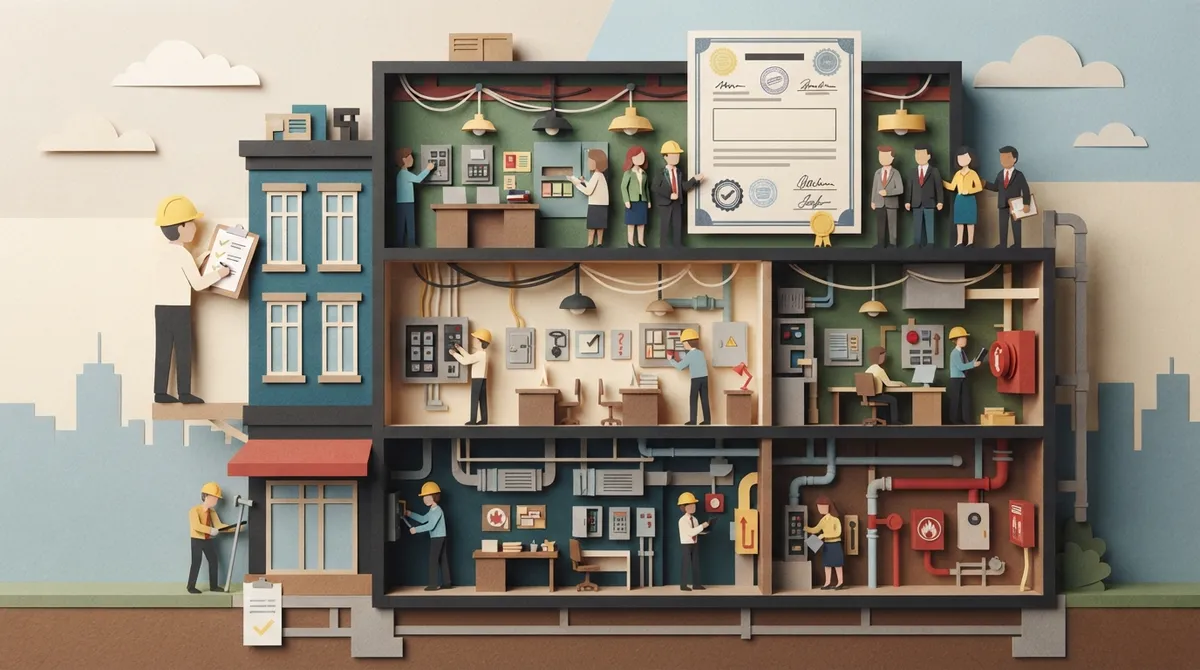
In the world of building recertification, a “commercial building inspector” usually means a Florida-licensed architect or engineer. This person inspects an existing building and writes reports that your local building department will accept. They are not the same as a home inspector or a general contractor.
Whether you run a condo association, manage an HOA, own an office plaza, or invest in aging apartment buildings, this guide will walk you through what to look for. We’ll cover what these professionals actually do, how to check their credentials, and how to avoid costly mistakes. Grab a coffee, and let’s make this simple together.
What Does “Commercial Building Inspector” Really Mean for Recertification?
The phrase sounds simple, but it hides a few important details. When owners in Broward and Miami-Dade Counties search for commercial building inspectors near me, they usually need a licensed design professional. That means a Florida-registered professional engineer or architect, not just anyone with a clipboard.
Here is why that matters. Miami-Dade County requires recertification reports prepared by a Florida-registered professional engineer or architect. The report must certify that the building is structurally and electrically safe for its specified use and continued occupancy. The county also says the professional needs training and experience in the technical field the report covers.
If you want a deeper look at the difference, our guide on who actually recertifies a building breaks it down in plain language. And if you are brand new to the topic, start with what building recertification is and why it matters.
Recertification vs. Milestone Inspection: Don’t Mix Them Up
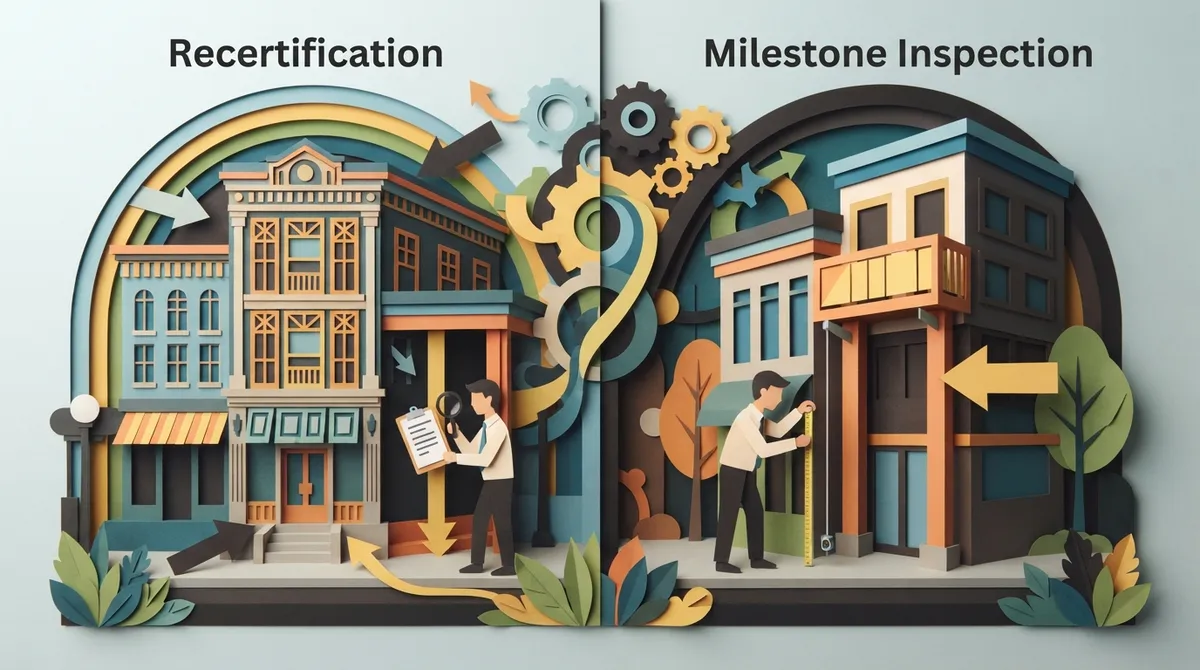
This is where many owners get tripped up. Local recertification and Florida’s milestone inspection law are two different things. They can overlap, but one does not replace the other.
Miami-Dade County and the City of Miami run their own local recertification processes. Florida’s milestone inspection statute is a separate state law. It covers buildings that are at least three habitable stories tall and subject, in whole or in part, to residential condominium or cooperative ownership.
| Feature | Local Building Recertification | Florida Milestone Inspection |
|---|---|---|
| Who sets the rules | County or city building department | State statute (Section 553.899) |
| Buildings covered | Depends on local program, age, use, and size | 3+ habitable stories with condo or co-op ownership |
| Typical timing | Set by the local program and your notice | Year the building turns 30, then every 10 years |
| Who inspects | Florida-registered engineer or architect | Florida-authorized licensed architect or engineer |
| Key step | Report submitted to local authority | Phase one, then phase two if needed |
Want to see how these rules play out in a specific place? Our article on milestone vs. recertification rules is a helpful example. You can also compare programs in SIRS vs. milestone inspection.
Which Buildings Need a Recertification Inspector?
The honest answer is: it depends on where your building is, how old it is, and how it is used. Always confirm with your local building department. Before you pick an inspector, gather these basics:
- The building’s exact location and jurisdiction
- Its use (office, retail, apartments, condo, industrial)
- Its age and certificate-of-occupancy date
- Its height and number of stories
- Its ownership type (single owner, condo, co-op)
- Any notice or deadline you already received
For many South Florida owners, a notice arrives in the mail and the clock starts ticking. If that sounds like you, take a breath. You are not alone, and there is a clear path forward. Our guide to recertification deadlines in 2026 can help you map out your timeline.
Miami-Dade Rules You Should Know
Miami-Dade’s guidance can call for separate structural and electrical inspections. Buildings that are four stories or taller, and buildings classified as threshold buildings, must be inspected separately by qualified Florida-licensed structural and electrical engineers. For threshold buildings, the structural report needs evidence of relevant experience and structural specialization.
Rules and forms change, so verify current details directly with the county. You can read the official guidance on the Miami-Dade County Recertification page, and you can look up a building’s status using the Miami-Dade building recertification case search.
What Do Commercial Recertification Inspectors Actually Inspect?
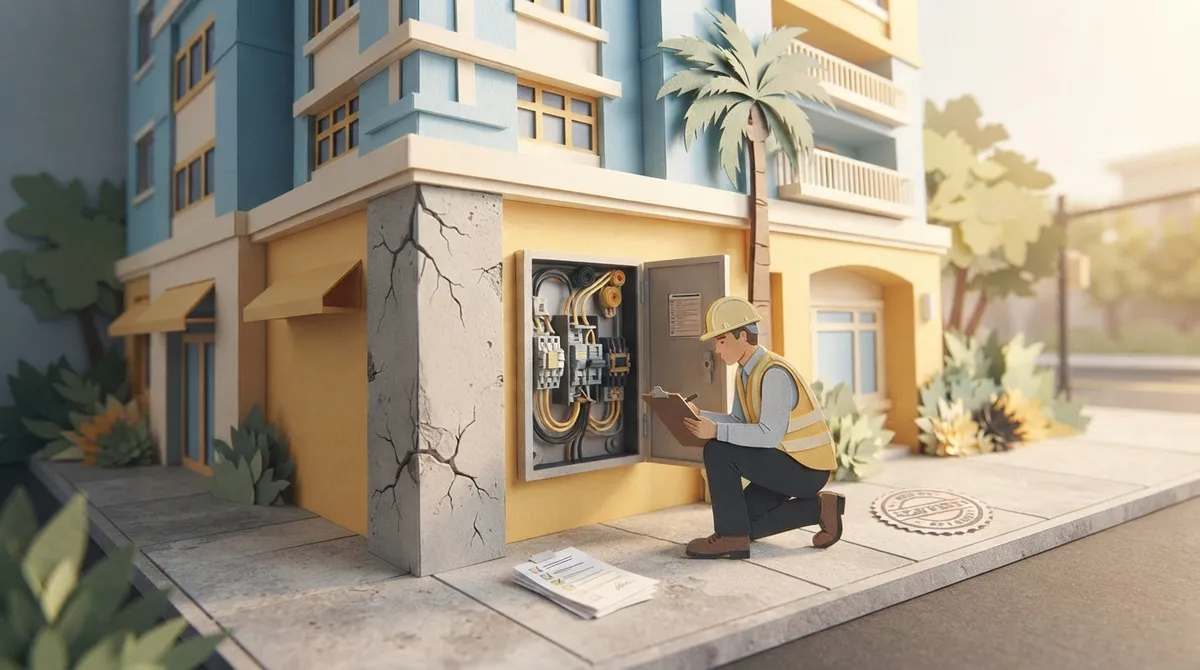
Think of it like a thorough health checkup for your building. The inspector looks at the parts that keep people safe and the building standing. Depending on your jurisdiction, that usually includes:
- Structural systems: foundations, columns, beams, slabs, balconies, roofs, and load-bearing walls
- Electrical systems: panels, wiring, grounding, emergency lighting, and exit lighting
- Safety-related items: conditions that affect continued occupancy
- Visible signs of deterioration: cracking, spalling, corrosion, and water damage
For a closer look at each side, read what structural inspections involve and 14 electrical inspection facts for recertification. For a broader view, see what a commercial building inspection really covers.
How the Florida Milestone Process Works
If your building falls under the state milestone law, the process has two possible phases. Phase one is a visual examination of habitable and nonhabitable areas, including major structural components. A Florida-authorized licensed architect or engineer performs it.
If the inspector finds substantial structural deterioration, phase two is required. That phase may include destructive or nondestructive testing. The professional then submits a sealed report and a separate summary of material findings and recommendations to the association or owner and the local building official.
Timing matters here. Under the 2025 statute, the general initial milestone inspection is due by December 31 of the year the building reaches 30 years of age, based on its certificate-of-occupancy date. After that, it repeats every 10 years. A local enforcement agency may require inspections at 25 years because of local conditions. Phase one must be completed within 180 days after the owner receives written notice from the local enforcement agency.
How to Find Commercial Building Inspectors Near Me You Can Trust
A quick online search will give you many names. Sorting the good fits from the risky ones takes a little homework. Here is a simple, step-by-step way to do it.
- Confirm your program. Call your building department and ask which recertification or milestone rules apply to your building.
- Check the license. Verify the professional’s active Florida architect or engineer license through the state.
- Match the specialty. Make sure they have structural or electrical experience that fits your building type.
- Ask about similar buildings. A team that has handled high-rises should know what threshold buildings demand.
- Confirm local know-how. They should know your jurisdiction’s forms and submission process.
- Review insurance. Ask for proof of professional liability coverage.
- Get the scope in writing. Know exactly what is included and what is not.
Need a longer checklist? Our guides on choosing licensed building inspectors and hiring a building inspector for recertification go step by step. Also, steer clear of common traps by reading 9 mistakes when hiring building inspectors near me.
Why Local Experience Makes a Real Difference
Here is a little story. Picture a condo board in Broward that hired an out-of-area firm because the quote looked cheap. The reports came back in the wrong format for the county. The board lost weeks fixing paperwork while the deadline crept closer. It was avoidable.
Local professionals know how the county reviews reports. They know the common issues in older South Florida buildings, like salt air corrosion and humidity damage. That knowledge saves time and stress. For more on this, see local vs. out-of-area structural inspectors.
How Much Do Commercial Recertification Inspections Cost?
This is the question everyone asks. The honest answer is that costs vary a lot. A Florida legislative analysis once estimated inspection costs of $2,000 to $4,000 for a small commercial building. It estimated $20,000 to $40,000 for a 15- to 20-story condominium in Miami-Dade and Broward.
Please treat those as historical estimates, not current quotes. Your actual fee depends on several things:
- Building size and complexity
- Site access and number of floors
- Whether testing is needed
- Your jurisdiction’s requirements
- The condition of the structural and electrical systems
When you compare quotes, ask what is left out. Repairs, testing, permits, and follow-up inspections are often excluded from the base inspection fee. Our article on building inspection cost mistakes and the guide to costs behind your 40 year recertification can help you budget wisely.
Why O’Reilly Consultants Is a Strong Choice for South Florida Owners
If you want a team that lives and breathes recertification, O’Reilly Consultants is built for exactly that. This small, highly specialized engineering team serves Broward and Miami-Dade Counties. Their focus is building recertification and safety-focused inspections for the real estate market.
Here is what sets them apart:
- Experienced leadership: Owner and qualifying architect Sherard O’Reilly brings deep experience with ASTM E2018 property condition assessments and careful building documentation.
- Deep bench: Construction Manager and Engineer Catalina Torres has 27 years of civil engineering and construction management experience. Project Engineer Rafael Ojeda has 16+ years in environmental due diligence and has completed over 1,000 Phase I Environmental Site Assessments.
- Modern tools: Drones and 3D laser scanning allow thorough evaluations, quick and accurate estimates, and detailed reports with clear, actionable recommendations.
- Full guidance: They walk you through the county notice, the hiring step, the documentation, and any repairs needed within mandated timelines.
They handle 10-, 25-, and 40-year recertification inspections for high-rise and multi-family apartments, offices, industrial buildings, and condos. Related services include electrical and illumination safety inspections, SIRS, PCA, and HOA reserve studies. That means one team can cover many of your compliance needs. Curious how it all fits together? Read the 8 key steps in the building recertification process.
Don’t just take our word for it. You can visit O’Reilly Consultants on Google and see what local owners and managers have to say.
Tips for Different Types of Property Owners
Every owner has a slightly different worry. Here is how to approach it based on who you are.
Condo Association Boards
Your priority is meeting the milestone timeline while keeping residents informed. Start early, because the 180-day phase one window begins once you receive written notice. Read 15 condo 40-year inspection mistakes to stay ahead.
Commercial Property Owners and Investors
Office towers, plazas, hotels, and aging portfolios need clean reports for insurance, refinancing, and sales. A missing or late report can slow a deal. Our guide to commercial building certification is a good place to start.
HOA Managers and Apartment Owners
You juggle many residents and many systems. A single inspector who can also handle PCAs and reserve studies simplifies your life. See property assessments for recertification in Florida for more.
What Should You Prepare Before the Inspection?
A little prep goes a long way. Gathering documents early helps your inspector work faster and can lower your total cost. Try to have these ready:
- The notice or letter from your building department
- Original plans, permits, and certificate of occupancy
- Past inspection or recertification reports
- Records of repairs, renovations, and tenant changes
- Maintenance logs for electrical, roofing, and life-safety systems
- Access arrangements for roofs, electrical rooms, and mechanical spaces
You can find a longer walkthrough in how to prepare for commercial building inspections in 2026 and how to prepare for a building safety inspection.
What Happens If the Inspector Finds Problems?
First, don’t panic. Finding issues is the whole point, and it is much better to catch them now than after a failure. If the inspection reveals structural deterioration or electrical deficiencies, the report will list them with recommendations.
From there, you typically plan repairs, pull any needed permits, and schedule follow-up inspections. Your local authority sets the timeline, so stay in close contact. A good partner helps you prioritize the most urgent safety items first and keeps the paperwork moving.
Ready to Take the Next Step?
Finding the right commercial building inspectors near me comes down to a few smart checks: the right license, the right specialty, local know-how, and a clear scope. Do those well, and recertification becomes a manageable project instead of a scary deadline.
If you want a friendly, experienced team to guide you, request a free quote from O’Reilly Consultants today. Prefer to talk it through? Call us at (512) 567-1191, and we will help you understand your next steps. You’ve got this, and we are here to help.
FAQs
Q: What does a commercial building recertification inspector inspect?
A: They look at the parts that keep your building safe, mainly the structural and electrical systems. That can include foundations, beams, balconies, roofs, panels, wiring, and emergency lighting. The exact scope depends on your local program, so always check with your building department.
Q: What is the difference between building recertification and a Florida milestone inspection?
A: Local recertification is run by your county or city, like Miami-Dade or the City of Miami. A milestone inspection comes from a state law for buildings with three or more habitable stories and condo or co-op ownership. They can overlap, but one does not replace the other, so confirm which applies to you.
Q: What qualifications should a commercial building recertification inspector have?
A: Look for an active Florida-licensed architect or professional engineer with structural or electrical experience that fits your building. Ask about similar projects, local program know-how, insurance, and a clear written scope. Miami-Dade also expects qualifications by training and experience in the field the report covers.
Q: How much does a commercial building recertification inspection cost?
A: Costs vary with building size, complexity, access, testing, and jurisdiction. One older Florida legislative estimate ranged from $2,000 to $4,000 for a small commercial building and $20,000 to $40,000 for a large condo, but those are historical figures. Ask for a current written quote and find out whether repairs, permits, and follow-up inspections are included.
Q: What happens if an inspection finds structural or electrical problems?
A: Your inspector will document the issues and recommend repairs. You then plan the work, get any needed permits, and schedule follow-up inspections within your local timeline. Starting early gives you the most breathing room.